


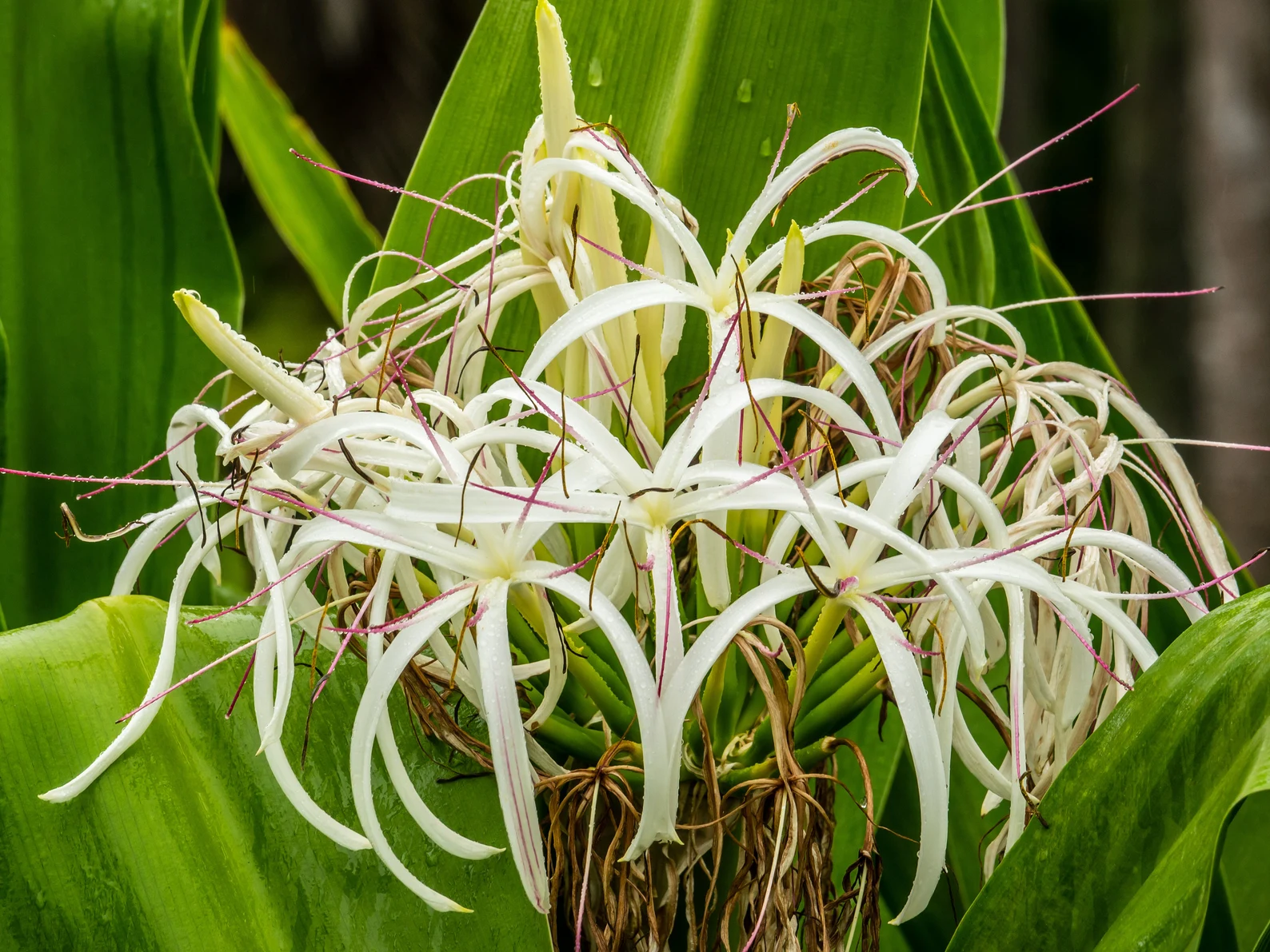
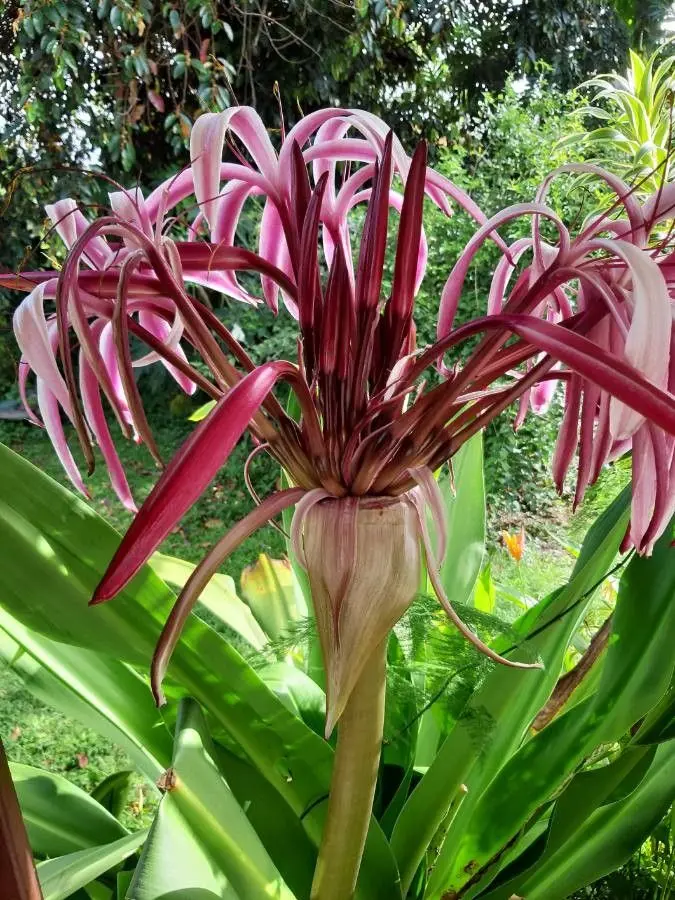
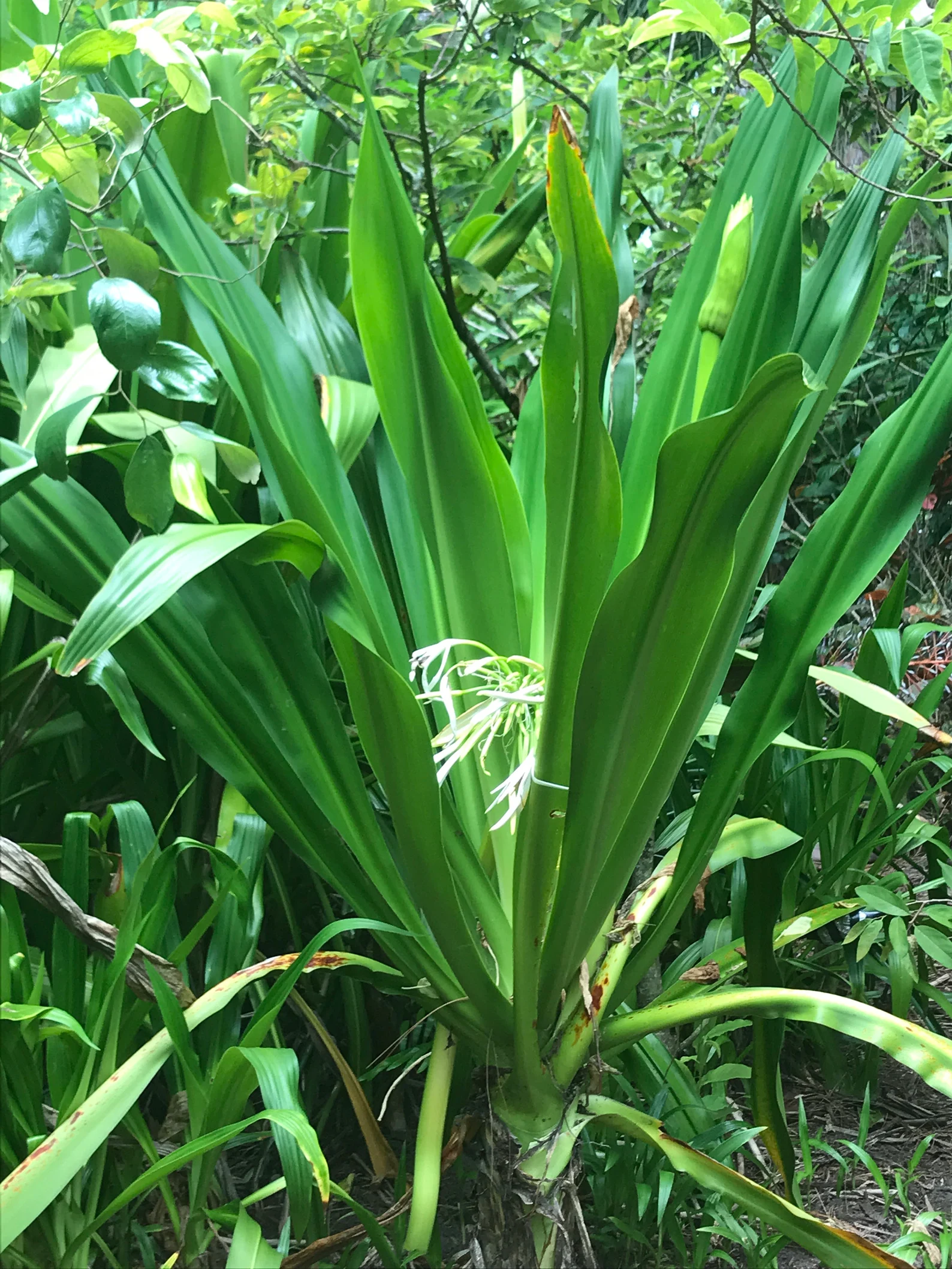
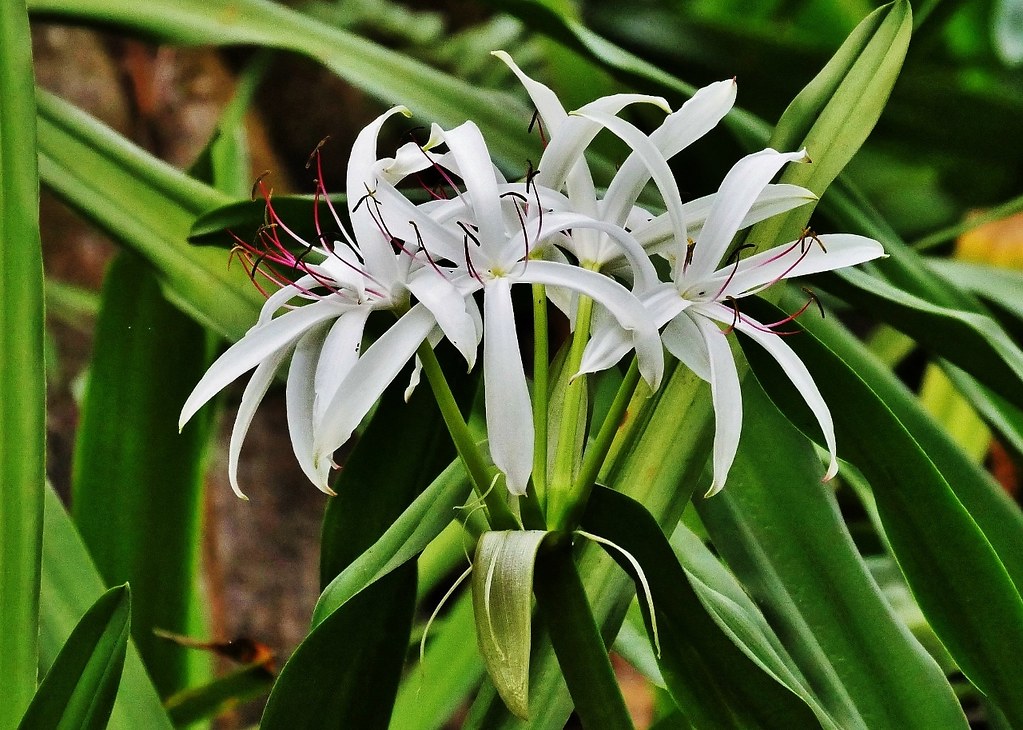


Crinum asiaticum is a perennial herb that typically grows up to 1.2 m (3.9 ft) tall. It has a leaf base. Its pseudobulb is spherical. The upper part of the bulb is cylindrical. The base is laterally branched, with a diameter of about 6–15 cm. Its leaves are lanceolate, margin undulate, apically acuminate. Their width is 7–12 cm or wider and they number 20-30. The inflorescence is an umbel with 10-24 flowers, six petaloid tepals, and aromatic. The flower stem is erect, as long as the leaf, and solid. The spathe is lanceolate, membranous, and 6–10 cm. The corolla is spider-like shaped, white, linear, revolute, attenuate, 4.5–9 cm long, and 6–9 mm wide. The corolla is 6-lobed. It has 6 reddish stamens. The filaments are 4–5 cm long. The anthers are liner, attenuate, ca. 1.5 cm long or more. The ovary is fusiform, and up to 2 cm long. The fruit is an oblate capsule, green, and 3–5 cm in diameter. The seeds are large, and the exotesta is spongy. The Queen Emma lily, a giant subspecies (Crinum asiaticum subsp. asiaticum) has flowers up to a foot which are a deeper shade of pink, and borne on a plant up to 6ft 7in in height.
The entire plant is toxic, especially the bulb. It contains a variety of alkaloids such as lycorine and tazettine. When eaten, it can cause vomiting, abdominal pain, severe diarrhea, constipation, irregular breathing, rapid pulse, fever, etc.; sufficient misuse can cause nervous system paralysis and death.
Although it is native to wet sites it will grow in moist garden environments or it can be planted in containers that are kept moist to wet. Only use a pot 2 inches larger than the bulb. If growing in the garden, mulch heavily in the winter. Otherwise, it can be grown in water gardens, along streams, ponds or bogs. It prefers full sun to partial shade. Do not disturb the bulbs once planted or it may take up to 2-3 years before it blooms again.
Reviews
There are no reviews yet.